Reishi, Tremella, and the Autumn Table
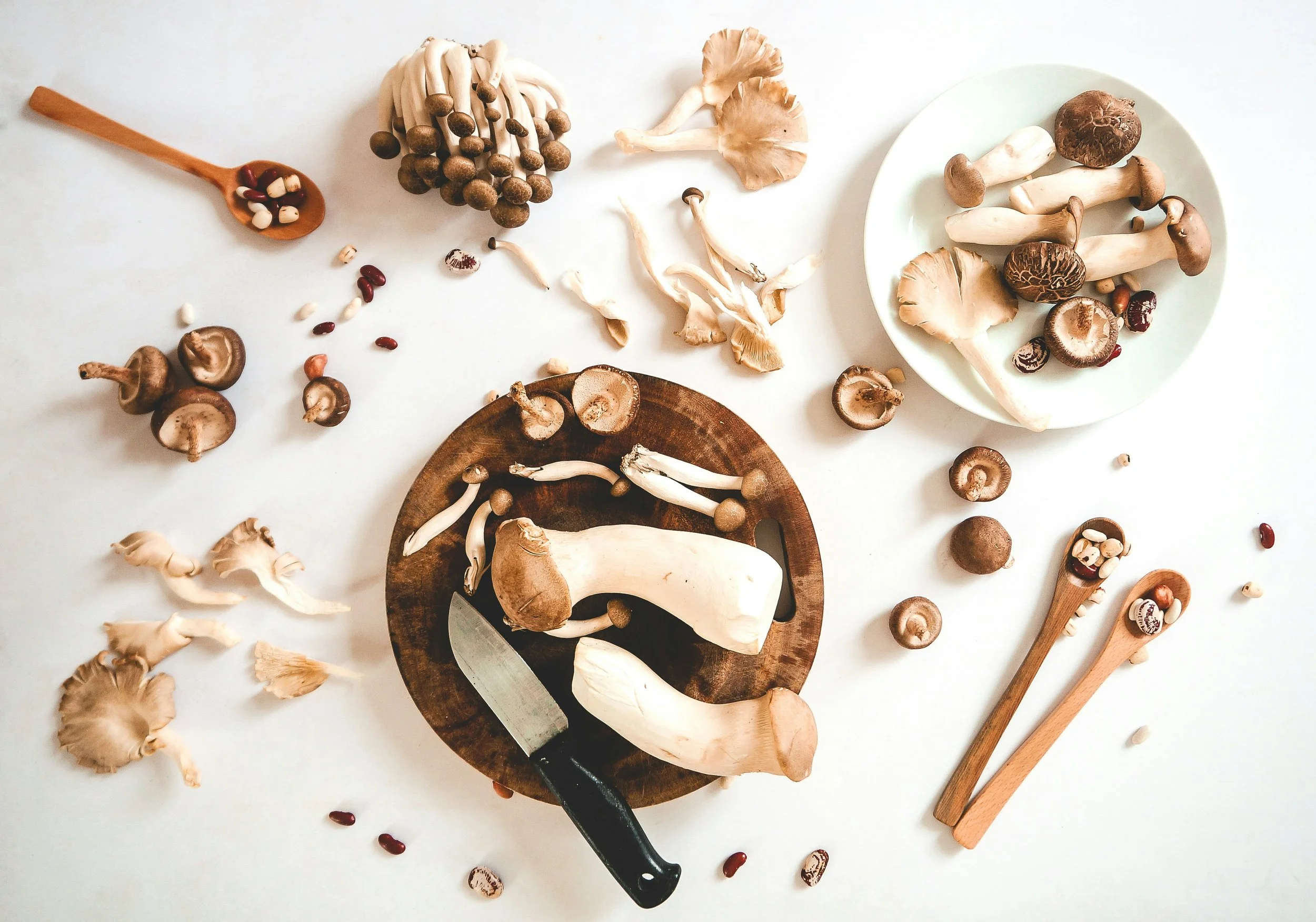
Mushrooms occupy an unusual place in the plant world, not plants at all technically, but close enough in how both traditions in this course have always worked with them that leaving them out of a materia medica would be a real gap. Reishi in particular carries one of the oldest reputations of any organism in Chinese medicine, referenced in Daoist alchemical texts as a literal symbol of longevity, sometimes called the mushroom of immortality, long before anyone understood a single thing about its actual chemistry.
Modern research has caught up to some of that old reputation. Several of the mushrooms in this module are now studied for their beta-glucans, polysaccharide compounds shown to interact with the immune system in real, measurable ways. That doesn't make the older language obsolete. It means two very different eras of observation arrived at a similar conclusion about the same handful of fungi.
That old reputation wasn't vague folk enthusiasm either. China's oldest surviving materia medica, the Shen Nong Ben Cao Jing, compiled around 200 CE, sorted every substance it covered into three grades: superior, middle, and inferior. The superior grade held only about 120 substances total, herbs and fungi considered safe enough for genuinely long-term daily use and capable of nourishing life over years, not just treating one isolated complaint. Reishi sat in that superior category alongside ginseng, astragalus, and licorice, some of the most trusted names in the entire tradition. Physicians two thousand years ago already trusted certain plants and fungi enough to recommend taking them consistently, which is the same logic behind most of this module's practices.
Reishi (Ling Zhi). Ganoderma lucidum.
Reishi is a hard, woody mushroom, one that is simmered or taken as a tincture, since its texture makes it genuinely unpleasant to chew. In TCM, it's classified as a Shen tonic as much as an immune tonic, calming and centering the spirit alongside its more commonly cited immune-supportive reputation, a dual role that reflects the mushroom's old alchemical status.
Working with it: sliced dried reishi, simmered for thirty to forty-five minutes, produces a bitter, earthy tea best softened with a little honey. It's a slow-building herb, most useful taken consistently over weeks, not reached for during an active illness.
Tremella (Bai Mu Er). Tremella fuciformis.
Tremella, sometimes called snow fungus or white fungus, is a pale, gelatinous mushroom with a long-standing reputation in TCM as a Yin tonic for the lungs, used specifically to moisten dryness the same way ophiopogon does in Module Two's herb list. It's also long been valued in Chinese beauty traditions, prized for skin hydration from the inside, a use modern research has started to take a real interest in given tremella's actual polysaccharide content.
Working with it: tremella needs to be soaked in water for twenty to thirty minutes before cooking, expanding significantly as it rehydrates, then simmered in a sweet soup with dried dates and goji berries, one of the most classic preparations in Chinese home cooking for exactly this kind of dessert soup.
Tremella's beauty reputation has a famous face attached to it in Chinese folklore. Yang Guifei, one of the Tang Dynasty's most celebrated beauties and remembered as one of China's legendary Four Great Beauties, is said to have credited tremella specifically when asked how she kept her complexion so radiant. Whether or not the story is literally true, it's been repeated for well over a thousand years, and is how tremella earned the nickname fountain of youth mushroom.
Cordyceps. Ophiocordyceps sinensis, or the more affordable cultivated Cordyceps militaris.
Cordyceps has one of the strangest natural histories of anything in this module, a fungus that grows by infecting a caterpillar underground, historically harvested wild in the high-altitude regions of Tibet and Nepal at real expense. In TCM, it's classified as tonifying both lung and kidney Qi, a plant that bridges this season directly into Winter's own territory. Genuine wild cordyceps is expensive enough that most modern use relies on cultivated Cordyceps militaris, grown on grain, not harvested from a caterpillar, with a similar though not identical profile.
Working with it: cordyceps is most commonly taken as a powder stirred into warm water or added to a soup, or as a tincture. It's considered a supportive, energy-building addition, not a fast-acting remedy for anything specific.
Cordyceps carries its own discovery story, passed down among Himalayan herders. High-altitude yak and goat herders in Tibet and Nepal noticed their animals grazing on a strange, dark, grass-like growth each spring, and afterward those same animals became noticeably more energetic, running and playing at an altitude where that behavior otherwise stood out. Curious herders started digging up and trying the fungus themselves, and by the time the Tibetan physician Nyamnyi Dorje wrote about it in the 1400s, cordyceps already held a settled reputation as a genuine vitality tonic.
Winter Squash
Winter squash, acorn, butternut, delicata, and their relatives, isn't a medicinal herb in the classical sense, but it earns a real place on this list as the season's central superfood. Its warming, sweet, earthy quality fits neatly into TCM dietary thinking, and its harvest timing lines up exactly with when Metal season most wants a warm, grounding food.
Working with it: roasted with a little of Module Two's fresh ginger and a pinch of cinnamon, winter squash becomes a beautiful medicinal dish, warming circulation and supporting digestion at the same time.
Honey
Raw honey holds a specific classification in TCM: sweet, neutral in temperature, and considered a lung tonic, used to moisten dryness and ease a sore throat in a way that overlaps directly with Western folk use of honey for a cough. It's one of the few substances claimed by both traditions in the exact same way, with barely any translation needed between them.
Working with it: a spoonful of raw, local honey stirred into warm ginger or thyme tea does real double duty, soothing an irritated throat directly while supporting whatever herb it's paired with.
Daoist Food-as-Medicine Principles for Autumn
Food-as-medicine, called yao shan in Chinese, is a distinct branch of Chinese medicine, standing alongside herbal formulas and acupuncture. Its most famous early text, the Yin Shan Zheng Yao, written in 1330 by Hu Sihui, the Yuan Dynasty's imperial dietary physician, is the oldest known dedicated work of dietary therapy anywhere in the world. Hu Sihui's job was keeping an emperor healthy through food alone.
Two organizing principles from that same tradition matter for Autumn specifically. The first is flavor. Each of the Five Elements carries its own flavor, and Metal's is pungent, the warming, dispersing quality found in ginger, onion, garlic, and white pepper. A little pungent food supports the lungs and helps the body's defenses stay alert as cold season approaches. Too much of it does the opposite, drying out the very tissue it's meant to help, which is why this principle is about moderation.
The second is color. Metal's color is white, and Autumn's traditional plate leans toward pale foods for exactly that reason, tremella, daikon radish, onion, pear, white sesame. This isn't decoration or superstition dressed up as medicine. Many of these pale foods concentrate real, measurable compounds, tremella's polysaccharides among them.
A third shift matters just as much. As the weather cools, Daoist dietary practice moves away from summer's raw, cold, quickly prepared foods toward slow-cooked, warming preparations, soups, stews, congee, the kind of cooking that mirrors what the season itself is doing outside. Raw and cold food in autumn is traditionally seen as an unnecessary strain on digestion at exactly the moment the body is trying to consolidate its reserves for winter, not the season to lean on smoothies and salads the way summer might have.
This is also where yao shan diverges from how modern wellness culture usually talks about a superfood. A superfood typically gets chosen for a single standout nutrient, isolated and marketed almost like a supplement in food form. Yao shan works differently: it asks what a food's overall nature actually is, its temperature, its flavor, its color, and its texture, and then asks what that whole nature is suited for in a specific body at a specific time of year. Tremella's real value lies in its entire character taken together, cooling, moistening, pale, gelatinous, a profile that matches exactly what a dry autumn lung actually needs.
Practices
The Congee Practice
Congee, plain rice slow-cooked in far more water than usual until it breaks down into a soft, warming porridge, is the actual backbone of Chinese dietary medicine, the base almost every medicinal food gets added to, not a dish eaten on its own. Its real value is digestive: congee asks almost nothing of the stomach to break down, which is exactly why it shows up constantly in a tradition built around not overtaxing the body's own resources. Hu Sihui's own text is full of congee variations built around whatever ingredient needed delivering that week.
Make a simple version this week: a half cup of rice to six cups of water, simmered slowly for an hour until it breaks down completely, with a few slices of dried Asian pear and a small piece of astragalus root added in for the last thirty minutes of cooking. Eat it plain, or with a drizzle of honey. Notice how different this feels in the stomach compared to a typical breakfast.
The White Foods Plate
Build one meal this week deliberately around Metal's color: tremella in a light soup, a little daikon radish, some onion or garlic worked into the cooking, a piece of Asian pear for dessert. Before you eat, take a moment to actually notice that every ingredient on the plate traces back to the same underlying logic, pale color, moistening quality, lung support. This isn't about eating an entirely white diet or treating color as a rule to follow blindly. It's a practice in noticing that an old classification system and a newer one can describe the same real thing in two different languages.
The Seventy Percent Practice
Daoist dietary philosophy carries an old rule of thumb worth taking seriously: eat until you're about seventy percent full, not until you're stuffed. The logic underneath it is about Qi, not restriction for its own sake. Digestion spends real energy, and a body working to break down more food than it actually needed has less Qi left over for everything else that season is already asking of it.
Pick one meal this week and eat it slowly, checking in with yourself partway through, not eating straight through to a full plate. Stop at the point where you're satisfied but could easily eat more, and simply notice what that feels like, since for most people it's an unfamiliar stopping point entirely.
Journal Prompts
Which of this module's five items did you already have some experience with, and which was entirely new?
Does the color and flavor logic behind Autumn's food choices feel intuitive to you, or does it take real effort to see the pattern?
What did the Seventy Percent Practice actually feel like in your body, compared to how you'd normally eat that same meal?
Where does food already function as medicine in your own life, even if you've never called it that?
Optional Reading and Resources
The Tao of Nutrition by Maoshing Ni and Cathy McNease. An accessible guide to TCM dietary therapy organized by condition and constitution, a useful next step for anyone who wants to take this module's food-as-medicine principles further.
Between Heaven and Earth: A Guide to Chinese Medicine by Harriet Beinfield and Efrem Korngold. Not food-specific, but an excellent, accessible companion to the Five Element and Yin-Yang material this module builds on directly.